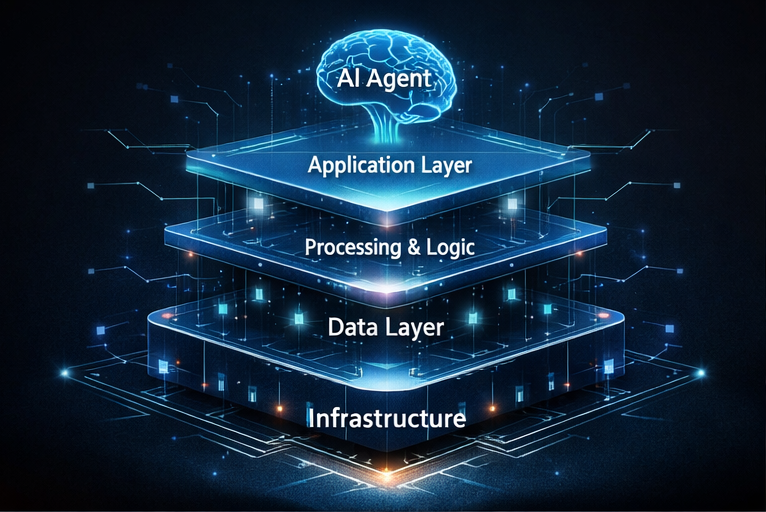

Agents have become a constant topic over the past year.
As systems move from conversation to execution and collaboration, one question keeps returning:
Will agents become the core of the next generation of enterprise systems?
Our answer, based on real projects, is more measured than many predictions.
Agents are important, but they do not determine how far an intelligent system can go.
That depends on the data, systems, and infrastructure beneath them.
01
Agent Integration Challenges
In a demonstration, an agent can appear capable of almost anything.
It understands intent, decomposes tasks, recommends actions, and may even reflect on its own output.
The problems appear quickly when it enters a real business system.
We have encountered scenarios where
- the agent understood the requirement accurately but repeatedly stalled during execution,
- produced contradictory conclusions at different times or through different entry points,
- or appeared intelligent while requiring human intervention at every step.
The model was not the problem. The system was.
An agent is not an independent intelligence. It is closer to a decision layer connected to the system through an amplifier.
The more disorganized the system, the more weaknesses the agent exposes.

02
Unclear data only amplifies ambiguity
In one project, we asked an agent to organize requirement-change records automatically and produce execution recommendations.
The initial result was inconsistent: when the same issue was triggered at different times, the agent reached completely different conclusions.
Investigation showed that the problem was not reasoning. It wasthe data sources themselves.:
- The same field came from several systems with inconsistent definitions.
- Historical data had no reliability classification.
- Several critical states depended on manual entry.
The agent was trying to reason over facts that the organization had never clarified.
Our first corrective action was not prompt tuning. It wasreturning to thedata foundation.:
- We defined the priority of each data source,
- added reliability markers to critical information,
- and prevented ambiguous data from participating in automated decisions.
Only then did the agent become consistent.
The lesson was clear: an agent will not solve an organization's data problems. It will expose them earlier.

03
Where Agents Get Stuck
When an agent cannot continue, the instinctive explanation is that it is not intelligent enough.
In practice, we have found a more consistent pattern:agents stall where the system has never defined its decision criteria.
For example:
- What conditions make an action ready for execution?
- When should a person intervene?
- Should a failure be retried or escalated?
People often handle these questions through tacit experience, but an agent cannot dependably guess the answer.
It repeatedly exposes the same fact:the underlying rule was never made explicit.
Part of an agent's value is not automation itself, but the pressure it creates for a system to confront uncertainty for the first time.

04
More Agents ≠ Better Results
A natural response to the limits of one agent is to introduce several agents that collaborate.
The outcome in practice is more complicated.
- For weaker models, multiple agents can improve reliability.
- For models with strong reasoning, additional agents may create more coordination cost than value.
Communication, division of responsibilities, and synthesis between agents form a systems-engineering problem of their own.
If the underlying data and rules remain unclear, multiple agents simply make the confusion more complex.
Collaboration is a designed capability, not an automatic gain.
05
Agents That Actually Work
After reviewing several projects, we reached a shared conclusion:
the agent understands intent, decomposes work, and contributes judgment,
while the infrastructure owns facts, rules, permissions, and auditability.
Infrastructure, in this context, is not one data platform, application, or technical component.
It is the complete set of engineering capabilities that allow AI to be invoked, constrained, validated, and connected to a business outcome.
That foundation can take several forms:
- a business system that accumulates dependable data over time,
- an application that connects users, data, and AI,
- or an engineering system spanning data capture, processing, access, and feedback.
Whatever form it takes, the objective remains the same:
bring intelligence into business operations instead of leaving it in a demonstration.
If an agent is a brain that can communicate, infrastructure is the body that allows it to stand and act.

06
Our view of the agent era
Agents will not replace systems. They are a new capability layer built on top of them.
They do not make infrastructure less important.
The opposite is true:they make the value of strong foundations visible for the first time.
For an enterprise, agent adoption is never as simple as choosing a model. It is the combined outcome of business, data, product, and engineering capabilities.
When a system becomes capable of moving work forward on its own,
the organization faces a new question:
Are you ready for the system to participate in decisions?
That readiness does not arrive at once, and no model launch can provide it automatically.
One point is certain:
the transition has begun and will not reverse.
07
Why We Build Infrastructure First
Across real projects, one lesson has been validated repeatedly:
an agent does not exist in isolation. It must operate on a complete infrastructure foundation.
That foundation is not one technology. It is a long-term systems capability in which three layers connect and reinforce each other continuously.
Layer 1: build customer touchpoints
Mobile apps, mini programs, and web systems create stable product entry points through which a company reaches its users.
These are more than interfaces. They are where data begins. Without authentic product use, the layers that follow have little meaning.
Layer 2: develop data assets
Continuously capture, process, and integrate user behavior and operational data into a unified data layer.
Every click and action becomes an understandable and reusable data asset
that supports later analysis, decisions, and automation.
Layer 3: use intelligence to drive growth
On a stable data foundation, Data + AI can combine operating metrics with user behavior.
The system can identify users dynamically, make decisions, and reach them at the right moment, then apply the result back to products, content, and interactions.
At that point,
the system beginsto improve the first-layer touchpoint in return.
Interactions improve, engagement becomes more relevant, and the resulting user behavior is captured and understood again.
A complete loop begins to form:
touchpoints generate data, data powers intelligence, and intelligence improves the touchpoints.
When these three capabilities continue cycling and reinforcing one another, AI stops merely appearing intelligent.
It becomes embedded in the business, contributing to engagement, conversion, and sustained growth.
That is the direction GeekOnUp continues to pursue.
We build for business growth, not for technology in isolation.
We believe
technology will become increasingly intelligent,
but it will always depend on strong, disciplined, and sustainable foundations.
Follow the GeekOnUp Technology Team。
for ongoing field experienceacross AI, product, and engineering,including practical lessons frommobile apps, mini programs, and web systemsbuilt for real operating environments.