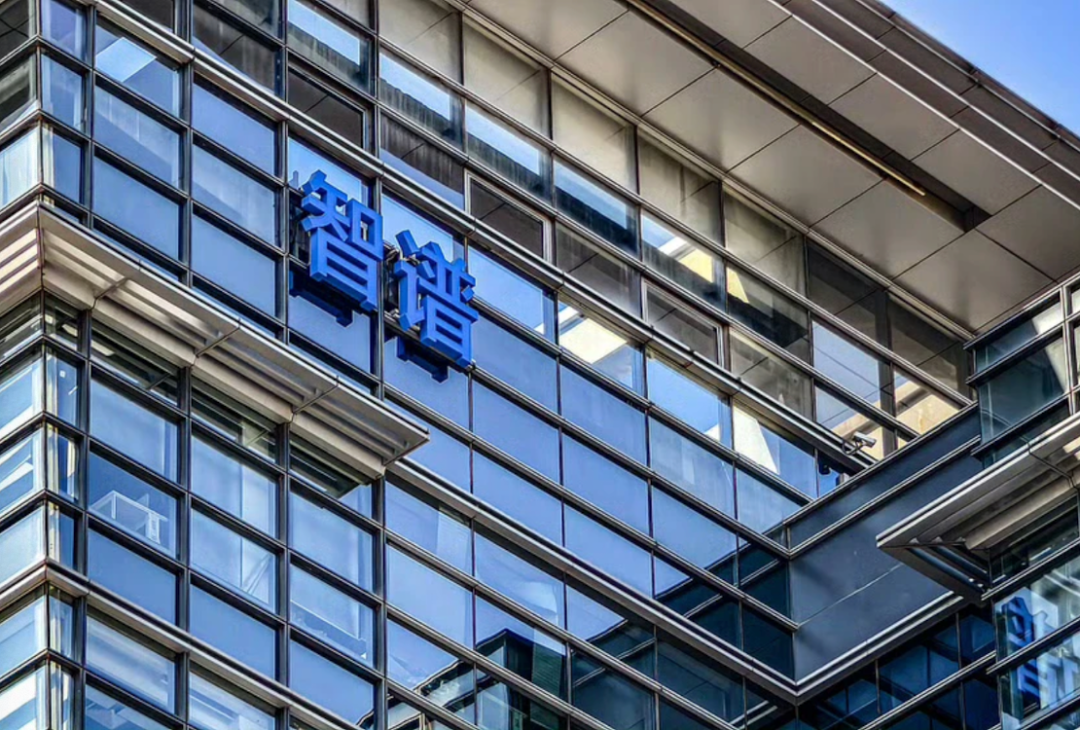

The opening bell rang in Hong Kong today,
marking Zhipu AI's public listing.Stock code: 2513

China's foundation-model sector has produced its first IPO,
described asthe world's first publicly listed large-model company.”。
What kind of AI company was the public market prepared to support first?
01
About Zhipu AI
Looking back at the company's development,
Zhipu followed a clear path that was rarely the easiest option.
The company emerged from a Tsinghua University laboratory but did not remain within an academic identity.
When GPT-3 captured global attention in 2020, Zhipu chose not to reproduce the same architecture.
It developed the original GLM pretraining architecture and became one of China's first companies to establish an open 100-billion-parameter model.。
More importantly, Zhipu generated revenue from its first day.
Its early technology-intelligence and data businesses gave the company an initial ability to finance its own operations.
In 2021, it also invested early in a Model-as-a-Service strategy.The platform now serves more than 2.7 million companies and developers.。
These choices share one characteristic:
they favor sustained operation over short-term attention.。
In an industry defined by rapid technology cycles and abundant capital,
that path more closely resembles a company designed for long-term market evaluation.
02
The listing validates more

The market showed exceptional demand for the offering.
The Hong Kong public offering was oversubscribed 1,159.46 times, while the international offering was covered 15.28 times.
What investors are supporting, however,
is not model capability alone. It is an operating structure designed for continuity.。
The prospectus reveals the tension between high growth and high losses.
From 2022 to 2024, revenue grew at a compound annual rate of 130%, followed by 325% year-over-year growth in the first half of 2025.
During the same period, cumulative R&D investment exceeded RMB 4.4 billion, and the company lost RMB 1.752 billion in the first half of 2025 alone.
Where did the investment go? A large share went into compute.
As the industry's release cycle accelerated, Zhipu open-sourced six models in less than three months following the rise of DeepSeek R1.
That high-intensity technology race increased costs directly.
Three capabilities are being tested
1. Can the models operate reliably over time?
The question is not only benchmark performance, but continuous service and improvement in real business settings.
2. Can the engineering system scale?
Training, deployment, inference, monitoring, and cost control all need to work together.
3. Does the business model close the loop?
Model capabilities must become understandable, billable, and reusable services.

03
Zhipu's most distinctive quality
Its shareholders represent a broad group of leading investors and strategic participants:
Meituan, Alibaba, Tencent, Sequoia, Hillhouse, and state-backed capital from Beijing, Hangzhou, and Zhuhai.
Their participation reflects more than confidence in the technology. It is also a judgment about the completeness of the company's structure.。
Zhipu does not build only models or only applications.
Its portfolio extends from the GLM foundation architecture to ChatGLM-6B, which accelerated open ecosystem adoption,
and to AutoGLM as a core model for AI agents.
Together, these create a chain from foundation models through domain adaptation to real applications.
Zhipu's extensive open-source strategy has produced more than 60 million downloads
and over 2,000 GitHub projects, creating an ecosystem advantage in the process.
Internationally, GLM-4.7 has led rankings for both open and Chinese-developed models.
The strategy is slower and requires more capital, but it is also more difficult to reproduce quickly.

04
The real challenge begins now
The listing should be interpreted clearly.
It does not mean that Zhipu's long-term path is already proven.
It means the company has entered a period of continuous public validation.。
As of June 2025, Zhipu held RMB 2.552 billion in cash and equivalents.
At a monthly burn rate approaching RMB 300 million, that cash would cover roughly nine months.
That helps explain a specific commitment in the prospectus:
70% of the proceeds will continue to fund large-model R&D.。
The technology roadmap will now be examined continuously, the cost structure analyzed repeatedly, and the business model compared with alternatives.
As a research-led organization becomes a public company, technical judgment must answer to engineering reality and market feedback at the same time.。
05
Conclusion
The next stage of competition will not happen only at the model layer.
It will take place where systems, engineering, data, and business meet.
AI does not create value at the moment a model launches.
Value begins to emerge after the model isintegrated into systems, invoked by real business processes, and governed by dependable data.,
That is when capability becomes operational.
As capital-market enthusiasm becomes more disciplined,
and technology narratives mature into sustainable business models,
the companies most likely to endure
will be those willing to establish strong foundations and build long-term capabilities one layer at a time.。
Think clearly and build deliberately.。